Tools for Improvement
Improvement often starts with understanding a challenge, gathering insight, testing new ideas, and learning from what works. This page brings together practical tools and frameworks that can support quality improvement, service redesign, project work, leadership, engagement, and evaluation.
Whether you are planning a new initiative, improving a service, developing your team, or gathering feedback, these resources can help you take a structured approach to improvement and change.
About These Resources
This page provides a selection of tools, frameworks, and approaches that can support improvement, innovation, service redesign, team development, and evaluation.
The resources featured here are not intended to be exhaustive. They are provided as a starting point for learning and exploration, and we encourage you to seek out additional evidence, guidance, and resources that best meet the needs of your work.
The important thing is not which tool you choose, but selecting an approach that helps you better understand a challenge, engage people, and make meaningful improvements.
Understanding Experiences and Perspectives
These tools help you explore the experiences of people who use services, colleagues, teams, and stakeholders.
- Journey Mapping - A way of visualising how people experience a service or process. Journey maps help identify touchpoints, challenges, gaps, and opportunities for improvement.
- Personas - Personas are fictional profiles based on real experiences and data. They help teams understand different user perspectives and design services around people's needs.
- Shadowing and Observation - Observing practice and environments can provide valuable insight into how services are experienced and where improvements could be made.
- Storyboards - Storyboards use visual storytelling to explore experiences, communicate ideas, and test new approaches.
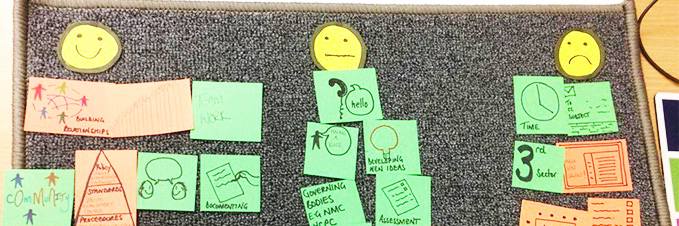
- Talking Mats - A visual communication framework that supports meaningful conversations and helps people express their views and preferences.
Engagement and Collaboration
These tools help teams work together, gather ideas, and involve others in improvement activities.
- Affinity Mapping - Organise information and group ideas into themes. This is particularly useful when analysing feedback, engagement findings, or workshop outputs.
- Claims, Concerns and Issues (CCI) - A structured way to explore what people think is working well, what concerns they have, and what improvements they would like to see.
- Stakeholder Analysis - Identify individuals or groups who may be affected by a project or change and consider how best to involve and communicate with them.
- Partnership Analysis Tool - Supports organisations and teams to explore, develop, and strengthen collaborative working relationships.
- Network Mapping - A visual way of understanding relationships, communication networks, and opportunities for collaboration.
Planning Improvement and Change
These tools support project planning, service redesign, innovation, and change management.
- Plan, Do, Study, Act (PDSA) - One of the most widely used quality improvement methods. PDSA helps teams test changes on a small scale, learn from the results, and make improvements before wider implementation.
- Driver Diagrams - Help identify the factors that influence improvement goals and create a clear plan for achieving change.
- The Change Model - A practical framework that supports sustainable change and improvement across health, social care, and organisational settings.
- Making Things Happen - A structured approach to breaking ambitious ideas into achievable actions and manageable steps.
- Product-Based Planning - A project planning technique that focuses on identifying the outputs required to achieve successful outcomes.
- Kano Model - A tool that helps organisations understand what matters most to service users and prioritise improvements effectively.
Problem Solving and Analysis
These tools help identify challenges, explore causes, and develop solutions.
- Five Whys - A simple but effective technique for identifying the root cause of a problem by repeatedly asking "Why?".
- SWOT Analysis - Explore strengths, weaknesses, opportunities, and threats to gain a clearer understanding of current situations and future possibilities.
- Gap Analysis - Compare current performance with desired outcomes to identify areas for improvement.
- Cause and Effect Diagrams - Also known as Fishbone Diagrams, these help teams explore potential causes of a problem and understand how different factors contribute to an issue.
- Value Network Analysis - Helps understand how value is created and exchanged between people, teams, services, and organisations.
Evaluation and Learning
Evaluation plays an important role in understanding impact and sharing learning.
- After Action Review - A structured team discussion that explores what was expected, what happened, what was learned, and what could be improved.
- Reflection Framework (What? So What? Now What?) - A simple approach to reflective practice that encourages learning from experiences and supports continuous improvement.
- Good Enough Evaluation Framework - A practical evaluation tool that helps teams gather evidence, demonstrate impact, and support decision-making.
- Run Charts - Visualise data over time to identify trends, variation, and the impact of changes.
- Evaluating Client Experience - Provides guidance on selecting appropriate approaches for gathering and evaluating feedback and experiences.
Culture and Team Development
Organisational culture has a significant influence on how improvement and change are achieved.
- Culture Map - Helps teams explore behaviours, assumptions, values, and influences that shape workplace culture.
- Values Clarification - Supports individuals and teams to identify shared values and establish a common vision and purpose.
- Workplace Culture Critical Analysis Tool (WCCAT) - A structured framework for observing and analysing workplace culture to inform improvement activities.
- Person-Centred Framework - Supports reflection on person-centred practice and helps teams consider how care and services can be shaped around people's needs.
Creativity and Innovation
Innovation often comes from thinking differently and exploring new possibilities.
- Happy Startup Canvas - A visual planning tool that helps people develop ideas, understand purpose, and communicate change effectively.

- Rip + Mix - A creative method for generating new ideas by combining, adapting, and building on existing concepts.
- NESTA DIY Toolkit - A collection of practical innovation tools designed to support creativity, experimentation, and problem-solving.
Additional Resources
The following collections provide access to a wide range of improvement methods, templates, and practical guidance:
Looking for a specific tool?
If you are not sure which method is right for your work, consider what you are trying to achieve:
- Understanding experiences > Journey Maps, Personas, Talking Mats
- Gathering ideas and feedback > Affinity Mapping, CCI, Stakeholder Analysis
- Planning change > PDSA, Driver Diagrams, Change Model
- Solving problems > Five Whys, SWOT Analysis, Cause and Effect Diagrams
- Evaluating impact > Run Charts, After Action Reviews, Evaluation Frameworks
- Developing teams and culture > Culture Map, Values Clarification, WCCAT